
A Matter of Mechanics: Big Ideas Taking Shape Through L’SPACE NASA
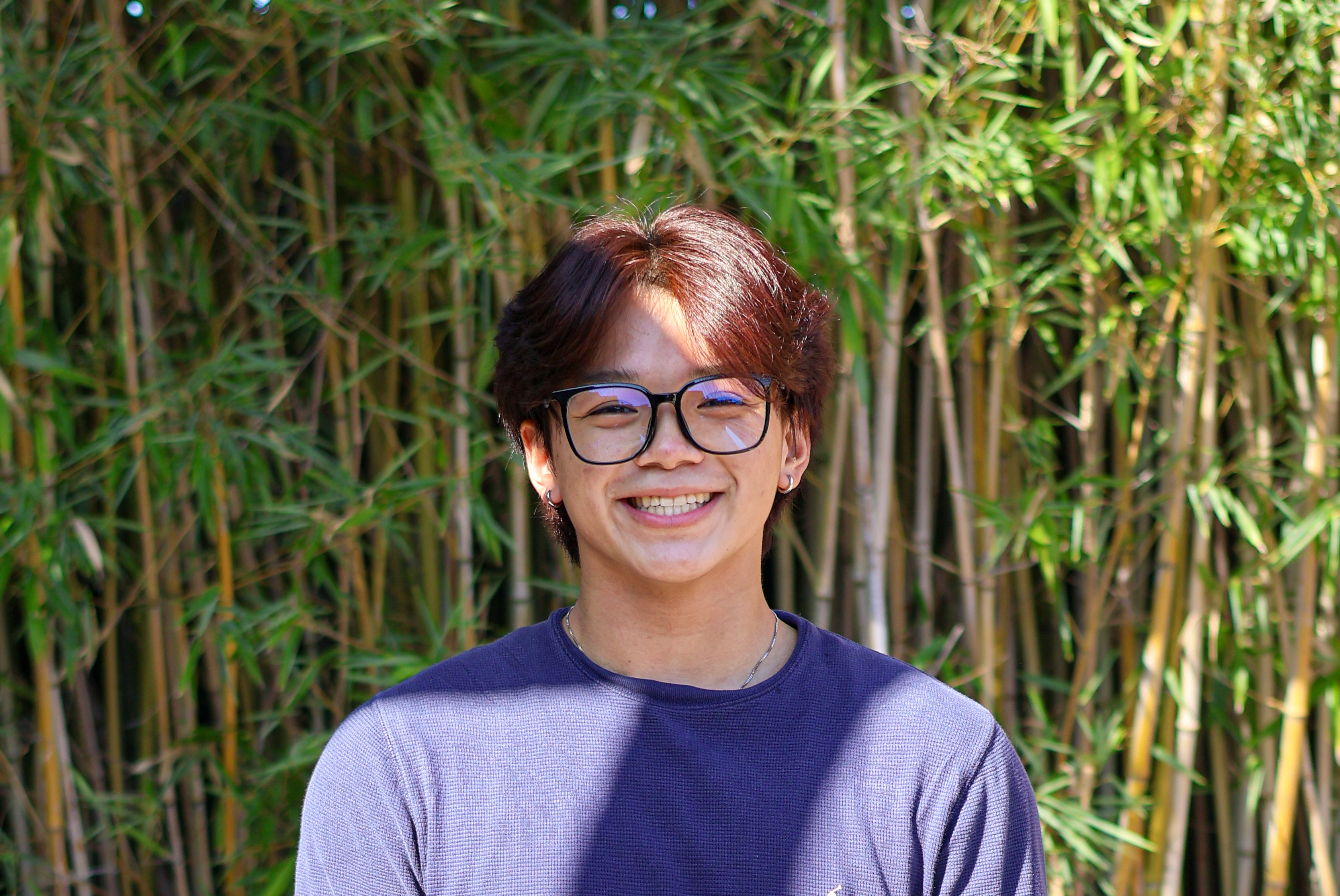
Meet Carl Michael Go, a sophomore majoring in Mechanical Engineering. As a participant in the NASA L’SPACE NPWEE Program, his team was recently awarded $10,000 in funding to develop Perovskite Solar Cells with Diamond-like Carbon Glass.
Growing up in a STEM-oriented environment, Carl originally saw himself pursuing Civil Engineering or Architecture. He spent time building computers and attempting to fix things around the house, however, as he explored those fields, he found they did not align with what he truly enjoyed. It wasn’t until college that he fully leaned into that curiosity and discovered that Mechanical Engineering (MEC) felt like the right fit.
Outside of the classroom, Carl is deeply involved across campus. He serves as the Event Coordinator for the Society of Hispanic Professional Engineers (SHPE), where he ensures that events run smoothly by coordinating the logistics. As a Sophomore Representative for the Society of Asian Scientists and Engineers (SASE), he promotes events, supports student engagement. In the American Society of Mechanical Engineers (ASME), he shadows executive board members to develop leadership skills. He also recently became an Autodesk Ambassador, where he plans to host Computer Aided Design (CAD) workshops in hopes of introducing students to industry software, even if they are outside of CEAS or STEM.
Motivated by the desire to gain hands-on experience and strengthen his professional growth, Carl applied to the NASA L’SPACE NPWEE Program. His team’s project focuses on developing a durable and efficient solar cell that is intended for long-term space missions. As the team’s Resource Manager, he oversees the materials, supplier and manufacturer research, and budgeting while also working with his team to conduct simulations and testing to evaluate the feasibility of their proposal.
For Carl, this experience has been very rewarding, seeing a large-scale idea take shape into something tangible has strengthened his confidence and helped clarify his evolving interests in mechatronics and entertainment technology. His journey highlights the importance of stepping outside your comfort zone and discovering something new about yourself along the way.
Read more about Carl Michael’s experiences below in an interview with CEAS Student Assistant Janice:
The Interview
Janice: What led you to studying Mechanical Engineering? Have you always intended on majoring in MEC?
Carl: I wasn’t always planning on majoring in Mechanical Engineering. In highschool, I was actually more interested in Civil Engineering or Architecture, but the more I explored those paths, the more I realized that they weren’t the right fit for me. I grew up being surrounded by STEM. I was always trying to fix things around the house and putting together computers. The curiosity was always there, but I didn’t really dive deeply into it until college. Through that exploration, I realized that Mechanical Engineering aligned best with what I enjoyed.
What is a fun fact about yourself that people might not know?
A fun fact about me is that I played volleyball in high school. I don’t play as often anymore, only from time to time, but I stay involved by helping manage the men’s volleyball team on campus. I will actually be traveling with them for the national division tournament soon!
As the Event Coordinator for SHPE, Sophomore Representative for SASE, and a mentee for ASME, and a new Autodesk Ambassador, what does your role look like in each organization?
As the Event Coordinator for the Society of Hispanic Professional Engineers (SHPE), I ensure that events run smoothly by booking rooms on time, managing reservations, and coordinating with the treasurer and graphic designer to make sure events are funded and are properly advertised.
For the Society of Asian Scientists and Engineers (SASE), I serve as a Sophomore Representative. My responsibilities include promoting general body meetings and events, flyering around campus, table at events such as involvement fairs, and participating in social media reels to increase engagement. I also represent the club in collaborations such as the upcoming PUSing-Along event.
Through the American Society of Mechanical Engineers (ASME), I’m currently a mentee shadowing executive board members like the vice president or secretary. I attend meetings, present my ideas, give feedback, and work on developing my leadership skills since I am interested in eventually pursuing an executive board position myself.
As an Autodesk Ambassador, I work to bring Autodesk to campus and promote it through events and LinkedIn posts. I also plan to host Computer Aided Design (CAD) workshops to introduce students to the software, even if they are outside of CEAS or STEM.
How did you come across the NASA L’SPACE NPWEE Program, and what motivated you to apply?
I first came across the NASA L’SPACE NPWEE Program through LinkedIn. I saw my peers participating in similar programs like NASA MCA, and I also knew Edwin Tan had taken part in L’SPACE. I applied because I wanted to put myself out there and gain experience that would help me become a stronger candidate for research and internship opportunities. I wasn’t sure if I would be accepted, but I realized that any experience like this would benefit my academic and professional growth.
If you are able to share, could you tell me about your project, the Perovskite Solar Cells with Diamond-like Carbon Glass, and the goal of this project?
Our project focuses on developing perovskite solar cells coated with diamond-like carbon glass to support long-term space missions, such as missions to Mars. Our goal is to develop an ultra-resistant solar cell that remains efficient over its lifetime while withstanding space debris, solar radiation, and general wear and tear. We want to design something that can reliably support teams on long-term missions, operating in harsh environments.
As the Resource Manager for this project, what are your main responsibilities, and what kind of challenges have you encountered while managing resources for a large-scale project?
As the Resource Manager, I am responsible for tracking the materials and determining the quantities needed for development, testing, and trial runs. I also research manufacturers and suppliers, and handle the pricing to ensure we stay within budget. I would say the biggest challenge has been determining the correct material quantities since the process is new to me and my team. It requires extensive research, while balancing our timeline and budget.
What stage of development is your project currently in, and when is it expected to finish?
Right now we are in the simulation and testing phase. We are using SolidWorks to conduct thermal testing and simulate how the material would react to radiation exposure. We haven’t built the physical prototype yet because we are still determining whether our initial concept is feasible or if adjustments are needed. Since we are all balancing academic responsibilities, our progress has been gradual, and we expect to finish around summer where we will present our final results.
What is your favorite part or most rewarding experience in this program so far?
The most rewarding aspect has been seeing our project evolve from an idea to something tangible, especially at such a large scale. In our day-to-day courses, projects often just feel like a grade, but this feels completely my own. Being recognized for our work makes it so much more rewarding and meaningful, and watching the project develop step by step has been incredibly satisfying.
How has this program influenced or clarified your career goals?
While aerospace and aeronautics are interesting to me, this experience gave me clarity that this might not be the field I ultimately want to pursue. Instead, I’ve become more interested in mechatronics, especially in entertainment technology like animatronics. Being involved in SHPE and attending their national conference they held last semester allowed me to reflect more on where I see myself in the long-term.
What advice would you give to students who want to get involved in leadership or E-Board roles, or programs like L’Space NASA?
My advice would be to put yourself out there. During my freshman year I was shy and hesitant to take the initiative and be active. I then realized that good grades don’t automatically lead to opportunities, you have to take the steps to actively pursue them. If you don’t take that first step, then those roles won’t come to you. It starts off uncomfortable but when you keep stepping out of your comfort zone, you eventually find something that fits you and that you genuinely enjoy. I’ve seen my peers earn roles they didn’t think they’d get simply because they decided to take that step.
Are there any resources from CEAS or Stony Brook you’ve found especially helpful throughout this experience?
I think Handshake has been very helpful in discovering opportunities, especially since many of them are first-come, first-served. I’ve also found CEAS advising and email announcements useful since many of the experiences I applied to came from those emails. I also make use of LinkedIn and Indeed, which is how I came across an opportunity to become an Autodesk Ambassador as well.