
Naomi Kirkup '25
BA Asian and Asian American Studies
Minors in South Asian Studies and Religious Studies
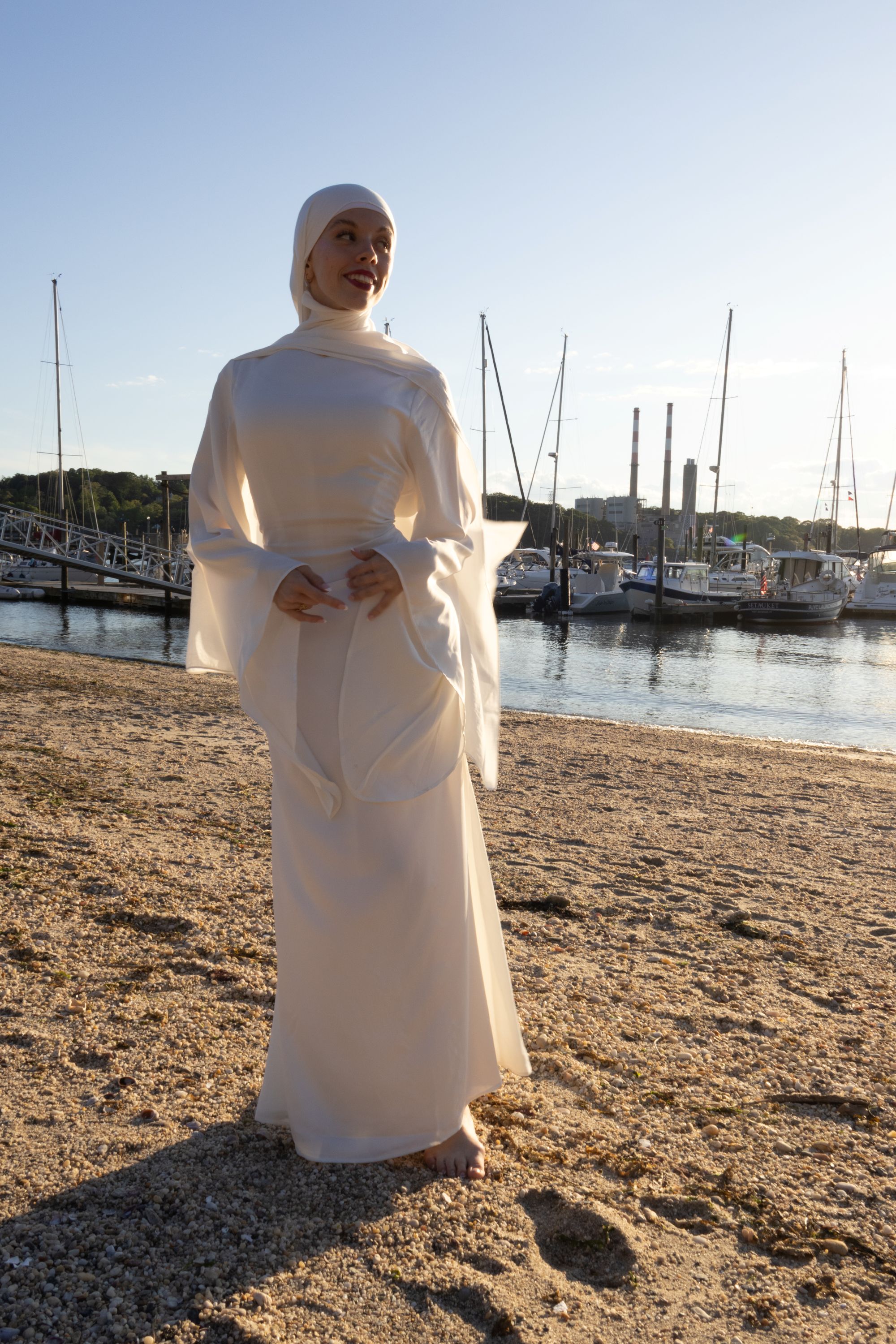 On Stony Brook:
Stony Brook University has provided me with an excellent education and has opened
so many doors for me. The Stony Brook Curriculum (SBC) requirements allowed me to
explore diverse fields and helped give me a more well-rounded view of the world. I
thoroughly enjoyed the classes I took for SBCs, an experience that is much different
from many others’ undergraduate experiences with their universities curriculum requirements.
This is a reflection of a great strength of Stony Brook University— it is flexible.
While it provides a well-known, top-notch education in STEM, the humanities and the
other disciplines are comprised of brilliant and passionate professors who care to
make their departments great and love to see their students succeed. Thus, fulfilling
SBC requirements like technology or arts, for example, was enjoyable although far
from what I might have otherwise chosen. Stony Brook University is a place where students
are truly able to succeed in their academic passions, extending far past its phenomenal
STEM programs.
On her major:
The Asian and Asian American Studies (AAS) department is a very special and charming
place. I majored in AAS and minored in South Asian Studies (SOA) and Religious Studies
(RLS), both of which are part of the AAS department. I have been supported as a student
by this department with a level of care that is truly rare. Not only did it prepare
me to pursue my education in graduate school, but it did so exceptionally well. AAS
is a wonderfully diverse department with many subfields, and the flexibility within
its major and minor requirements made it easier for me to graduate with these accomplishments.
It was not only my own professors who supported me, but also others in the department
who encouraged me and provided academic opportunities.
The professors in this department are brilliant researchers who deeply love their
work as educators at Stony Brook University. They have created—and continue to sustain
with incredible dedication—a department with both a warm environment and excellent
academics. I have so much love for this department and will always highly recommend
it. I am forever grateful to each professor in AAS; I can still feel them cheering
me on in graduate school.
Most of my coursework centered on my field, Religious Studies, but I also took four
semesters of Chinese language and many other cultural and historical courses. I can
especially speak to the excellence of the professors in RLS as people, scholars, and
educators. As a graduate student, I can confidently say that the education they gave
me as an undergraduate far exceeds that of many programs. The subtlety within the
philosophies of diverse religions is brought to light by these professors and taught
skillfully to students like myself, enabling me to reach understandings that extended
far beyond academics. The work done here is transformative; if you listen carefully,
they disclose the secrets of the universe—derived from true scholarship and a passion
that exceeds even that.
The professors here have vastly different backgrounds and niche fields, but their
overall perspectives are remarkably united. In particular, I appreciate the post-colonial,
anti-orientalist approach that characterizes their teaching. This is found not only
within the RLS subfield at Stony Brook University, but throughout the AAS department
as a whole. For example, the AAS symposium this past spring emphasized a unified post-colonial
approach to scholarship, even across presentations by students with widely varying
topics. One of AAS’s greatest strengths is its cohesion between diversity and unity.
The fields, perspectives, and professors are diverse, yet the department remains united
through its post-colonial orientation and its shared love for teaching.
Favorite class:
While it is incredibly difficult to choose, my favorite class may have been Memory
and the Self (AAS 472), a topics course taught by Dr. Timalsina. It integrated the
modern Western understanding of the relationship between memory and the self, familiar
to most students, with an Indian philosophical perspective, with a special emphasis
on Abhinavagupta. I chose this course as my favorite not only because the topic itself
is fascinating, but because Dr. Timalsina tied everything together so beautifully
at the end. He helped students realize that philosophy can be liberating—not only
in an ultimate sense, but in a conventional sense as well.
This realization was reflected in my final term paper, “I Am Alive: Abhinavagupta
and C-PTSD’s Mental Death,” which explored how Abhinavagupta’s philosophy may allow
true healing for individuals with complex post-traumatic stress disorder (C-PTSD).
The message of that paper was rooted in one of Dr. Timalsina’s key points, which subtly
illuminated the course from beginning to end: the light of consciousness, or the self,
is always shining, always alive, and the afflicting memories misidentified as the
self can be separated from That.
Favorite SBU memory:
My favorite memory at SBU is my departmental graduation, where I had the honor of
delivering the commencement speech. It was a fitting and meaningful close to my undergraduate
career, made even more special by the presence of my family and the genuine support
of the department.
Plans for post-graduation:
I am continuing my studies of Sufi philosophy and other great traditions at the University
of Virginia's Masters program.